
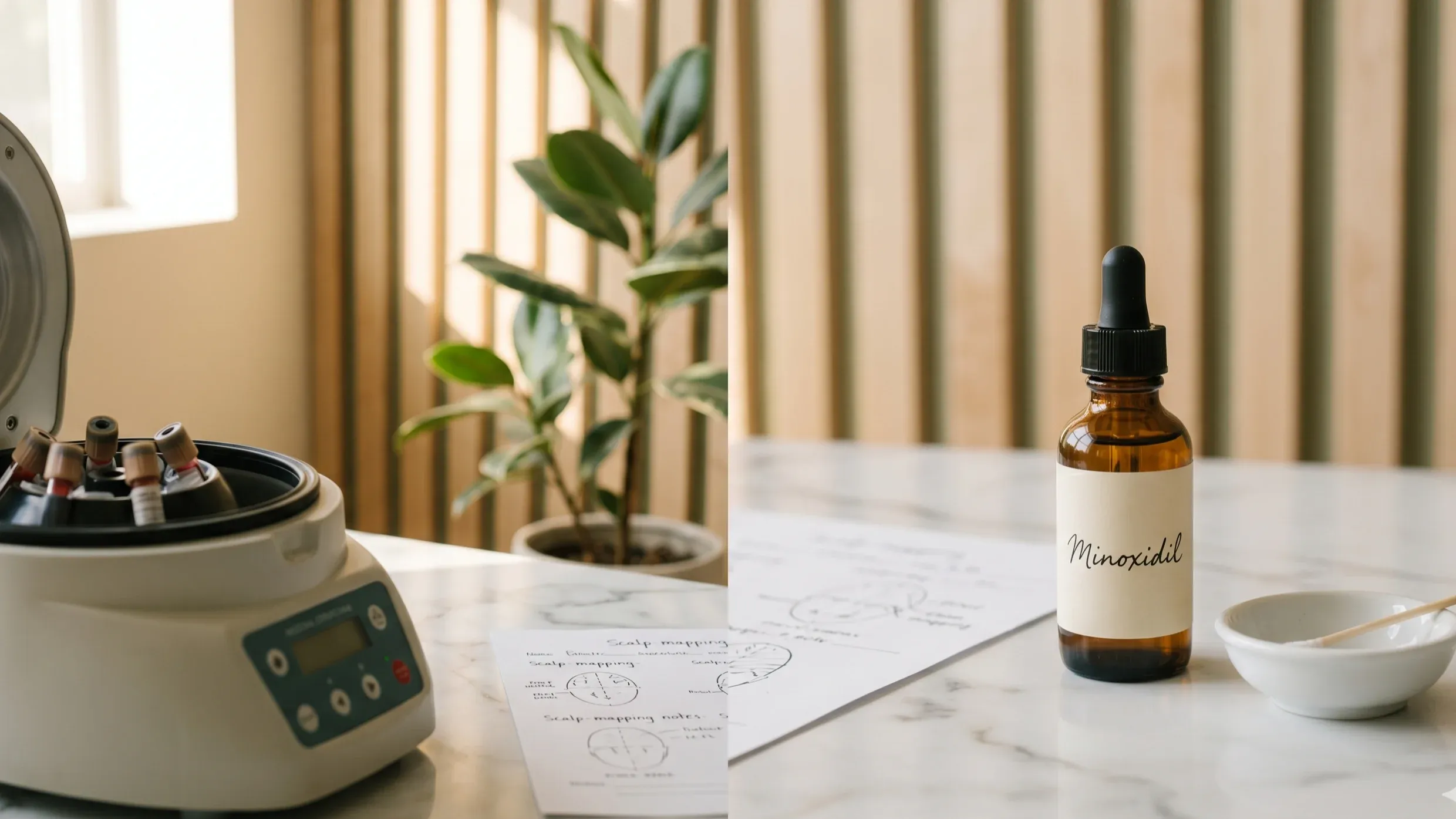
PRP vs minoxidil for hair loss — which one (or both) is right for you?
Almost every patient who walks into SkinWise with hair fall has heard the same two options: minoxidil and PRP. They get pitched as alternatives — do you want the cream or the injection? — when they’re actually two completely different tools that often work best together.
This is an honest comparison of what each one does, who it suits, and why “both, in the right order” is more often the answer than “pick one”.
What each one actually is
Minoxidil is a topical (or, less commonly, oral) medication originally developed for blood pressure that turned out to have a surprising effect on hair follicles. It widens scalp blood vessels, extends the active growing phase of each hair follicle, and slows the miniaturisation that drives pattern hair loss. You apply it once or twice daily, every day, indefinitely.
PRP (platelet-rich plasma) is a procedure where a small amount of your own blood is drawn, centrifuged to concentrate the platelets and their growth factors, and then injected back into the scalp in the thinning areas. The growth factors signal nearby follicles to wake up, thicken and stay in their active phase longer.
They’re not the same kind of intervention. Minoxidil is a long-term maintenance therapy you apply at home. PRP is a periodic clinic procedure that boosts follicle activity in concentrated bursts.
How they compare
| Minoxidil | PRP | |
|---|---|---|
| Format | Topical solution / foam, daily (or oral, prescribed) | Clinic procedure, course of 4–6 sessions then maintenance |
| What it does | Extends hair growth phase; slows miniaturisation | Stimulates follicles with growth factors |
| When you see results | 3–4 months (shedding first, then regrowth) | 3–4 months after starting the course |
| Maintenance | Daily, indefinitely | Every 4–6 months once trajectory turns |
| Cost | ₹500–₹1,500 per month for topical brands | ₹6,000–₹10,000 per session |
| Best for | Early-to-moderate pattern hair loss; supportive in telogen effluvium | Pattern hair loss; thinning crown / parting; post-pregnancy fall once stabilised |
| Side effects | Initial increased shedding (4–6 weeks, expected); scalp dryness; rarely facial hair | Mild scalp soreness 24h; no systemic effects |
| Stop and what happens? | Gains regress over 6–12 months | Maintenance gap of 4–6 months is usually fine; longer gaps see slow drift |
Who minoxidil suits
Minoxidil works for the largest share of patients because pattern hair loss is the most common cause of progressive thinning, and minoxidil directly counteracts it.
It’s a good first step if:
- Your hair fall is gradual rather than sudden
- You’re seeing widening at the parting (women) or recession at the temples / crown (men)
- You can commit to daily application for at least 4 months before judging it
- You’re prepared for an initial increase in shedding around weeks 4–6 (this is the medication working, not failing)
Where minoxidil is not the right answer alone:
- Telogen effluvium from a fever, COVID, surgery, or weight loss — these usually recover on their own with good nutrition; minoxidil helps but isn’t the main lever
- Alopecia areata (patchy hair loss) — different disease, different treatments
- Iron-deficient hair fall — fix the iron first; minoxidil only helps if the follicles have the building blocks they need
Who PRP suits
PRP works best when the follicles are still alive but underperforming. It’s most useful as an accelerator on a scalp that’s already on a stable medical foundation — not as a rescue therapy on a scalp that hasn’t had any intervention.
Good candidates:
- Pattern hair loss in early-to-moderate stages
- Female pattern thinning at the crown and parting
- Patients who’ve already been on minoxidil for 3–4 months and want to push the regrowth further
- Post-pregnancy hair fall that hasn’t recovered after 9–12 months
- Anyone who can commit to 4–6 sessions, spaced 4 weeks apart
Where PRP under-delivers:
- Very advanced pattern baldness (Grade VI–VII in men) — transplant evaluation is more useful
- Scarring alopecias (lichen planopilaris etc.) — needs different treatment
- Telogen effluvium that’s still actively shedding — wait until the shed stabilises before adding PRP
Why combining them works so well
In our experience at SkinWise, the strongest results come from running them together, in a specific order:
- Diagnose first. Iron, ferritin, vitamin D, B12, thyroid panel — read before prescribing anything. About a third of hair-fall patients have a fixable nutritional or hormonal driver that no topical will fix on its own.
- Start minoxidil as the medical foundation. Give it 3 months to settle (including past the initial shedding phase). This builds a stable platform.
- Add PRP as the accelerator at month 3. A course of 4–6 sessions, 4 weeks apart, pushes regrowth visibly above what minoxidil delivers alone.
- Move to maintenance. Continue minoxidil daily; quarterly PRP sessions to hold the gains.
For most pattern hair loss patients, this combination outperforms either treatment alone by a meaningful margin — and it’s what we end up recommending in nearly all moderate-thinning consults.
Frequently asked questions
Is one safer than the other? Both are well-tolerated. Minoxidil’s main side effect is initial increased shedding (it’s the medication working) and occasional scalp dryness. PRP uses your own blood with no foreign agents, so systemic side effects are essentially absent — local soreness for 24 hours is the most common complaint.
Can I do PRP without ever starting minoxidil? Yes, and many patients do — particularly those who can’t commit to a daily topical. PRP alone produces real gains; just smaller than the combination.
Will I need oral medication (finasteride / spironolactone) too? Some patients benefit, particularly men with strong hereditary patterns or women with PCOS-driven hair fall. We discuss it transparently, with the side-effect profile.
How quickly will I see results? Either way: 3–4 months for visible regrowth. Anyone selling “results in 4 weeks” is selling the wrong thing.
Do salon-style “PRP-like” treatments work? Generally no. The clinical effect comes from the platelet concentration and the injection placement, both of which are medical-grade steps. Most spa-style mesotherapy with “growth factor cocktails” is closer to a vitamin shot than a PRP procedure.
Where to go from here
If you’re early in the hair-fall journey and haven’t started anything, a hair-loss consultation is the right first step — we’ll read your bloodwork, look at your scalp under trichoscopy, and decide which of minoxidil-alone, PRP-alone, or both makes sense for you.
If you’re already on minoxidil and not seeing what you expected, the most common reasons (in order) are: not enough time (under 4 months), inconsistent application, or an unaddressed iron / thyroid issue. We can audit your current plan and either adjust or add PRP into the mix.
Related reading: