
By Dr Khushboo Sethia · Dermatologist, SkinWise Clinic Published Last reviewed
Nail infections: why they hide, and how to actually clear them
Nail infections are one of those problems patients live with for years before doing anything about it. The toenail thickens; it yellows at the tip; it crumbles slightly when cut. None of it hurts. So it gets covered, painted, ignored. By the time the patient arrives in our clinic — usually because the infection has spread to a second nail, or a wedding is coming up — the infection has been there for two years and embedded deep in the nail bed.
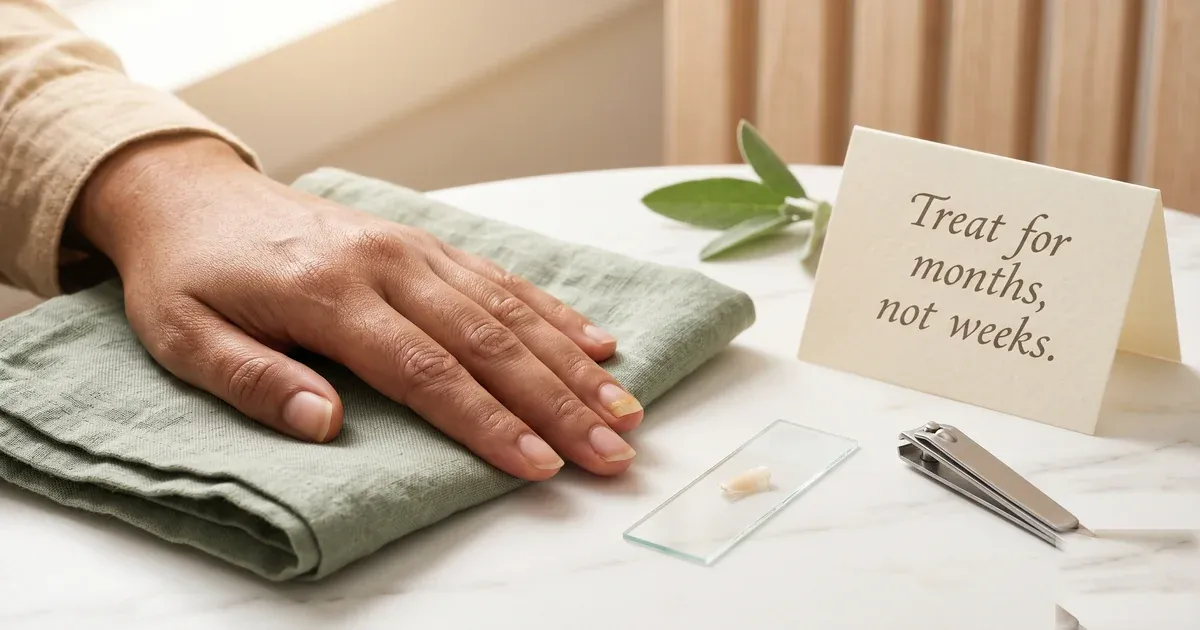
The honest truth about nail infections: they are very treatable, but they take time, the right diagnosis, and a longer treatment course than most patients expect. Short-cutting any of those three is why infections drag on indefinitely.
Here’s how we approach nail infections at SkinWise — what they actually are, why nails are so hard to clear, and what a real treatment plan looks like.
What “nail infection” actually means
Three distinct things hide under this label, and they’re treated very differently.
Fungal nail infection (onychomycosis)
By far the most common. The same fungal organisms that cause athlete’s foot or tinea on the body can colonise the nail plate and bed. The nail becomes thickened, discoloured, brittle, or lifted off the bed. Toenails are far more commonly affected than fingernails (warm, dark, moist environments inside footwear are ideal for fungus). About half of all thick discoloured nails in adults are fungal.
Sub-types matter for treatment:
- Distal subungual onychomycosis — starts at the tip; most common
- Proximal subungual — starts at the cuticle; often signals immune compromise
- White superficial — patchy white islands on top of the nail
- Total dystrophic — the whole nail destroyed, end-stage
Bacterial nail infection (paronychia)
Infection of the skin around the nail (the nail fold), not the nail plate itself. Acute paronychia presents with redness, swelling, throbbing pain, and sometimes visible pus. Causes: a hangnail, an aggressive manicure, nail-biting, or a paper cut that got contaminated. Chronic paronychia is a slower, less inflamed swelling along the cuticle line — commonly seen in people whose hands are wet a lot (cooking, dishwashing, healthcare) — and is usually a mix of Candida yeast and irritant exposure rather than classic bacteria.
Viral lesions around or under the nail
Most commonly periungual warts (HPV) — small rough growths next to or under the nail edge. Painful, slow-growing, and notoriously hard to clear because nail nearby protects the virus. See our warts guide.
There are also several non-infectious conditions that mimic nail infection and routinely get misdiagnosed:
- Nail psoriasis — pitting, oil-spot discolouration, separation of the nail; needs treatment for psoriasis, not antifungals. See our psoriasis guide.
- Trauma — the nail responds to chronic minor trauma (tight shoes, sport) by thickening and yellowing
- Subungual haematoma — a bleed under the nail looks black and is sometimes mistaken for melanoma or infection
- Subungual melanoma — rare but serious; a dark streak along the length of the nail that doesn’t resolve needs urgent evaluation, never just antifungal cream
Telling these apart on a glance is genuinely hard. This is one of the most-misdiagnosed-from-the-outside areas of dermatology, which is why we test before we treat.
How nail infections present
Common features across types:
- Discolouration — yellow, white, brown, black, or green
- Thickening of the nail plate
- Brittleness, crumbling at the edge
- Separation of the nail from the nail bed (onycholysis)
- Visible debris under the nail
- Soreness or pus around the nail fold (paronychia)
- Foul smell in long-standing infections
- Pain or distortion in nail growth
Toenails are more commonly affected than fingernails (about 4:1 in our clinic). The big toenail is the single most common site.
What lets the infection in
- Repeated water exposure (cooking, dishwashing, healthcare, lab work)
- Hot, sweaty, occlusive footwear
- Trauma — short cutting, tight shoes, sport, nail-biting
- Aggressive manicures and unsterile salons
- Athlete’s foot — fungus crosses from skin to nail easily
- Diabetes, peripheral vascular disease, immune suppression
- Smoking — reduced peripheral circulation slows clearance
Why nail infections take so long to clear
The single thing patients underestimate: the nail itself is dead tissue that grows out slowly. Even after the fungus is killed, the visibly affected portion has to grow out and be trimmed away. Fingernails take 6 months to grow out completely; toenails take 12–18 months.
This is why a 4-week antifungal course of cream — which is plenty for tinea on the body — barely scratches the surface for a nail. Real nail-infection treatment is measured in months.
Our approach to nail infections at SkinWise
Step 1: confirm what we’re treating
We don’t treat thick yellow nails empirically. A nail clipping or scraping goes to the lab for KOH microscopy and fungal culture, sometimes PCR. About a third of nails that look classically “fungal” turn out to be psoriasis, trauma or something else — and treating those with antifungals delays the real fix by months.
For paronychia, we examine the nail fold, sometimes culture pus if present.
For unexplained dark streaks, mole-like lesions, or single-nail dystrophy in an adult: dermoscopy and, where indicated, biopsy — to rule out melanoma.
Step 2: treat what we found
For fungal nail infection (onychomycosis)
Treatment depth depends on how many nails are involved and how deeply.
Topical-only (for early, distal, single-nail involvement, or when oral therapy isn’t suitable):
- Ciclopirox or amorolfine nail lacquer, daily or weekly per protocol
- 6–12 months minimum, often longer
- Better penetration when the nail surface is first thinned in clinic
Oral antifungals (for moderate to severe disease, multi-nail involvement, or topical failure):
- Terbinafine — most commonly used; daily for 6 weeks (fingernails) or 12 weeks (toenails)
- Itraconazole — pulse dosing in some cases; useful when terbinafine isn’t suitable
- Fluconazole — alternative in selected cases
- We screen liver function before and during longer courses
- We discuss drug interactions, particularly with statins and other common medications
Combination (topical + oral) for resistant or extensive cases.
Nail avulsion (partial or full removal of the nail under local anaesthetic) for cases where the nail is so distorted that medical treatment alone can’t reach the infection effectively. Usually a last step, not a first.
Laser for fungal nails exists, has limited evidence, and is generally not our first choice unless oral therapy is contraindicated.
For acute paronychia
- Warm soaks
- Topical or oral antibiotics depending on severity
- Drainage of pus if present
- Care of underlying trauma (stop nail-biting, address the manicure cause)
For chronic paronychia
- Address water exposure — gloves for wet work, cotton gloves inside rubber
- Topical anti-inflammatory plus antifungal cream
- Avoid cuticle pushing and aggressive manicures
- Treat any associated dermatitis on the hands
For periungual warts
- Cryotherapy
- Topical salicylic acid courses
- Sometimes electrocautery or immune-modulating creams in resistant cases
- These take patience — periungual warts are among the slowest to clear
Step 3: rule out the source
If the toenail infection is fungal, we look for and treat any athlete’s foot or interdigital tinea — without that, the toenail will keep getting reinfected.
We also screen for diabetes and peripheral vascular issues in older patients with recurrent infections.
Step 4: nail care during and after treatment
- Keep nails trimmed flat; file thickened nail edges to improve topical penetration
- Stop the manicure routine that caused or contributed to the problem
- Cotton socks; rotate shoes between days so each pair dries fully
- Antifungal powder in shoes during and after treatment
- Replace nail clippers used during the active infection
- Don’t share nail tools
What not to do
- Don’t apply random nail polish remover and over-the-counter antifungal cream and hope. Some help; most don’t penetrate the nail plate adequately; and you’ve made the diagnosis harder for the next dermatologist by treating it for months.
- Don’t book a gel manicure over an infected nail. The seal traps moisture; the trauma of removal compounds the problem.
- Don’t self-prescribe oral antifungals. Drug interactions and liver-function issues are real. Need monitoring.
- Don’t pull at a lifted nail. Further detachment from the bed seeds infection deeper.
- Don’t share clippers, files, or footwear.
- Don’t ignore a single new dark streak in a single nail. Always worth a dermatologist look to rule out melanoma. Most are benign; the missed ones are catastrophic.
- Don’t stop treatment when the nail looks better. It looks better because new clear nail is growing in — but until the entire affected portion has grown out and been clipped, the infection isn’t gone.
Frequently asked questions
How long until my toenail looks normal? Even with a successful course, the new clear nail takes 12–18 months to fully grow out and be clipped. The first signs of improvement appear at 3–4 months at the cuticle.
Is oral terbinafine safe? For most healthy adults — yes, for the durations we use, with monitoring. Liver function is checked before starting and during the course. We adjust or switch for patients with hepatic disease, certain drug interactions, or pregnancy/breastfeeding.
Why does the nail look worse before it looks better? The dead, infected nail material has to grow out and be trimmed. As the new healthy nail pushes from underneath, the diseased portion can lift and appear more obvious before it’s clipped.
Can I paint over a fungal nail? We discourage it during active treatment — nail polish reduces topical penetration and traps moisture. Once the infection is clearing and the nail looks healthy, occasional polish is fine.
Why does this keep coming back to me? Common reasons: untreated athlete’s foot reinfecting the toenail, shared footwear, persistent occlusive shoes, undiagnosed diabetes, or stopping treatment early.
Are gel manicures a problem? For most people, occasionally — no. Done frequently with aggressive removal, they’re a leading cause of paronychia and chronic nail damage in our female patients.
Will the infection ever truly “go away”? Yes, with proper treatment. Recurrence risk drops sharply when athlete’s foot is treated in parallel and good shoe/sock hygiene is maintained.
My fingernail has a dark line on it — is this nail melanoma? It can be. A new, lengthwise dark streak in a single nail in an adult always warrants dermatologist evaluation. Most are not melanoma — but the cost of missing one is severe.
Where to go from here
If your nail has been thick, discoloured, or distorted for more than a few months, the right next step is a consultation — bring photos of the nail at its worst and a list of everything you’ve already tried. We’ll examine, send a sample for proper diagnostic testing, and start treatment as soon as the diagnosis is clear.
Related reading: