
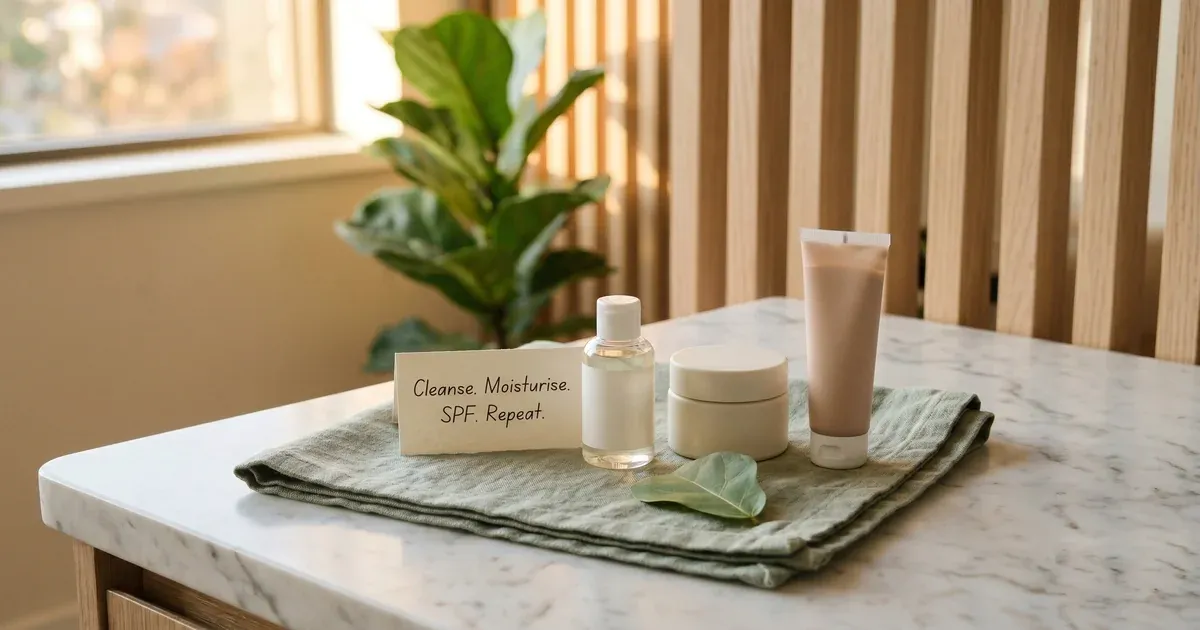
Minimalist evidence-based skincare routine for Indian skin by Dr Khushboo Sethia, SkinWise Clinic Bengaluru.

By · Dermatologist, SkinWise Clinic Published Last reviewed

Minimalist skincare: the boring routine that actually works

Most of the patients who come to us for adult acne, melasma flares, sensitive skin, or “my skin won’t calm down” aren’t under-treating themselves. They’re over-treating themselves. Vitamin C in the morning, acid toner at noon, niacinamide before lunch, retinol at night, two serums, a mask twice a week, a Korean essence stacked on top of a French sunscreen — and the skin is angry, dehydrated and pigmenting.

The honest dermatology answer almost always points the other way. Use less. Be consistent. Let the skin do the work it’s already designed to do, and only add an active when there’s a specific reason to.

This is what we mean by minimalist skincare at SkinWise — and why, for Indian skin in particular, it almost always outperforms maximalism.

What “minimalist skincare” actually means

It’s not skipping skincare. It’s the smallest possible routine that does what the skin needs, with each step picked for a clear reason and used for long enough to matter.

For most patients, that comes down to:

  • A gentle cleanser in the morning and evening (one product, not two)
  • A barrier-supportive moisturiser that suits your skin type
  • A daily broad-spectrum SPF 50 sunscreen with adequate amount and reapplication
  • One — at most two — targeted actives in the evening, used consistently, for a defined goal

Everything else is optional, and most of the time, optional is a polite word for unhelpful.

Why minimalist works better — especially for Indian skin

Three reasons we keep returning to.

1. The skin barrier is the foundation. Over-routining damages it.

Cleansing twice with acid-based washes, layering AHA + BHA + retinol + vitamin C through the week, weekly scrubs, weekly masks — the cumulative effect on the stratum corneum is wear. The barrier thins, water loss rises, the skin becomes reactive, and the patient ends up adding more products to manage symptoms the over-routining caused.

A calm, intact barrier is the precondition for almost every result you actually want — clearer acne, faded pigmentation, less sensitivity. We can’t fix anything well on a barrier that’s been stripped.

2. Indian skin pigments after every inflammation.

Post-inflammatory hyperpigmentation (PIH) is the defining vulnerability of Fitzpatrick III–V skin. Each unnecessary irritation — a too-strong acid, an aggressive scrub, a misused retinol — leaves a faint pigmented imprint. Multiplied over a year of maximalist routining, the skin looks more uneven than it would have on a deliberately simpler regimen.

The minimalist routine isn’t cautious for the sake of caution. It’s cautious because in our skin, over-treatment is the most common cause of the pigmentation patients are trying to fade.

3. Consistency beats novelty.

Almost every active worth using takes 8–12 weeks to show effect. Patients who rotate through trending products every three weeks never give anything long enough to work — and then conclude that nothing works. Five products used consistently for a year do more than thirty products used erratically.

The SkinWise minimalist core

This is what we recommend to almost every patient with no specific dermatology concern. It’s also the foundation we anchor every more complex plan around.

Morning

  1. Gentle, low-pH, fragrance-free cleanser. Rinse-off. No scrubbing.
  2. Lightweight moisturiser suited to skin type (gel for oily, cream for dry, ceramide-rich for sensitive).
  3. Broad-spectrum SPF 50 sunscreen. Two finger-lengths for face and neck. Reapplied at midday or when outdoors. Tinted with iron oxides if you’re pigmentation-prone. Sunscreen is half the treatment for everything — see our Indian-skin sunscreen guide.

Evening

  1. Same gentle cleanser. Double-cleanse only if wearing heavy sunscreen or makeup — and even then, the first cleanse should be an oil/balm and the second the gentle cleanser, not two surfactants stacked.
  2. One targeted active (if indicated). Most often a topical retinoid, started slowly and built up over weeks.
  3. Moisturiser. Lock in.

That’s it. That’s the routine. If everything else fell out of your bathroom shelf and only these stayed, your skin would be visibly better in six months than it is today on a 12-step regimen.

When to add an active — and how to do it right

A minimalist routine doesn’t mean never adding actives. It means adding them for a defined reason, one at a time, with enough time between additions to see what each one is doing.

The actives worth using most often:

  • Retinoid (adapalene 0.1%, tretinoin 0.025%, retinol) — the workhorse for anti-ageing, acne and pigmentation. Start 2 nights a week, build to nightly over 8–12 weeks. Pea-sized amount.
  • Vitamin C — antioxidant brightening; morning use; 10–15% L-ascorbic acid or a stable derivative.
  • Niacinamide — tone, barrier, oil control; safe in most regimens; 5–10%.
  • Azelaic acid — gentle multi-tasker for sensitive, melasma-prone or acne-prone skin.
  • Targeted depigmenting topicals — hydroquinone, tranexamic acid, kojic acid, alpha arbutin — used as part of a specific pigmentation plan, not casually.
  • AHA / BHA at low concentrations, used 1–2 times a week, not daily.

How to add them without breaking the routine:

  • One new product at a time. Six weeks before adding the next.
  • Pair with extra moisturiser, not extra acids.
  • Skip the day after if the skin felt irritated, then return the next night.
  • Drop the product if it doesn’t help after 12 weeks. Not every active suits every skin.

Lifestyle is half of skincare

The unglamorous truth about glowing skin: most of the visible improvement we see in our patients comes from changes that have nothing to do with creams.

  • Sleep. 7–8 hours, consistent times. Skin repairs at night. Chronic sleep debt shows up as dullness and slower healing.
  • Hydration. Water through the day, not all at once.
  • Sun exposure. Limit unnecessary midday sun; wear sunscreen daily; use a hat when outdoors.
  • Diet. Not perfection — but reducing high-glycaemic refined foods, very high dairy, and ultra-processed snacks reduces acne and inflammation meaningfully. Adequate protein and omega-3 helps barrier integrity.
  • Stress. Real, measurable effect on skin — flares of acne, eczema, urticaria, psoriasis are stress-aware. Manage it as part of a skincare plan, not separately.
  • Smoking and excess alcohol. Both accelerate skin ageing and pigmentation. We mention this once and patients can do what they want with the information.
  • Iron, vitamin D, thyroid, B12. We test when the history points there. A skincare routine on an undiagnosed deficiency doesn’t deliver.

What not to do

  • Don’t chase trends. “Slugging,” “glass skin,” “skin cycling,” “probiotic essences” — some have merit, most are marketing. Wait to see if a trend survives 12 months of dermatology scrutiny before adopting.
  • Don’t cleanse three times a day. Twice is the maximum for almost all skin.
  • Don’t scrub. Physical exfoliation in Indian skin is a leading cause of PIH and irritation. Chemical exfoliation done correctly is gentler and more controlled.
  • Don’t mix actives at home without understanding the interaction. Vitamin C + retinol + AHA + BHA + niacinamide in one routine is a barrier disaster. If you can’t explain the order of your routine clearly, simplify.
  • Don’t expect a cream to do a procedure’s job. A serum will not unwrinkle established frown lines, will not lift mature acne scars, will not remove a mole. The realistic upper limit of topicals is meaningful but bounded.
  • Don’t skip sunscreen because “it makes me oily.” Modern non-comedogenic formulations exist; finding the right one is a week-long experiment, not a reason to abandon SPF.
  • Don’t reach for new product when stressed about skin. Stress + new product is the recipe for an irritation. Stay with the basics; investigate the trigger.

Frequently asked questions

How long until I see results from a minimalist routine? Visible barrier improvement within 2–4 weeks. Tone and texture changes from added actives over 8–12 weeks. Real pigmentation correction over 3–6 months.

Can I keep my serums and just simplify cleansers and moisturisers? Yes — most often we simplify the cleansing side first, then audit the actives. Many patients are running 5 actives when 1–2 would do more.

What if I have specific concerns — acne, melasma, sensitive skin? The core stays the same; we add one or two specific actives matched to the concern. Minimalism doesn’t mean ignoring the problem — it means treating it precisely.

Are Korean skincare routines bad? No, but the 10-step framework was never meant as a daily prescription for every skin. The principles inside it (gentleness, layering hydration, consistency) are sound; the volume is what often gets people into trouble.

Do I need a separate eye cream? For most people under 35, no — your regular moisturiser is fine around the eyes. From mid-30s onwards, a dedicated cream with retinoid or peptide can be useful in selected patients.

Is one expensive product better than three cheap ones? Sometimes. Often what looks like an expensive product is just the same active in a prettier bottle. Active concentration, formulation stability and tolerance matter; price doesn’t always track those.

Can I use only sunscreen and moisturiser? For many patients with no specific concern — yes. Add a cleanser and you have a complete daily routine.

Where to go from here

If you’re overwhelmed by your current routine, or you’ve been chasing the next trend and your skin keeps complaining, the right next step is a consultation. We’ll audit what you’re using, strip it back to the essentials, and add only what you actually need — based on your skin, not on what’s trending this month.

Related reading:

Book a consultation with Dr Khushboo

Book consultation