
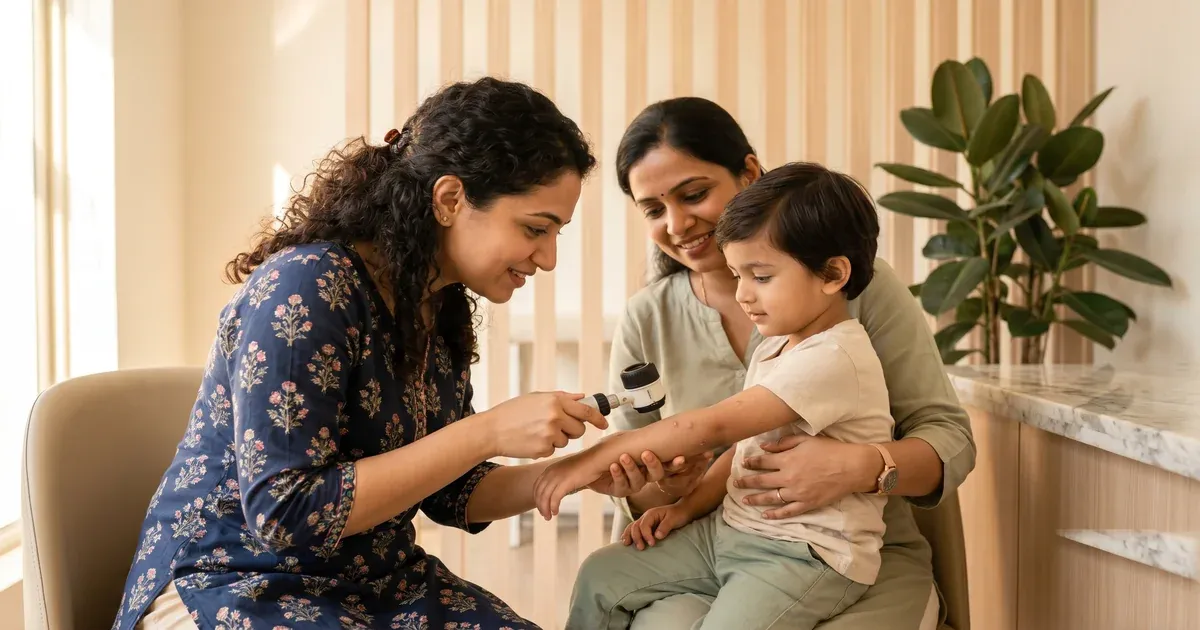
Molluscum contagiosum treatment for children and adults at SkinWise Clinic, Bengaluru.

By · Dermatologist, SkinWise Clinic Published Last reviewed

Molluscum contagiosum: the small pearly bumps that take their time

Most molluscum contagiosum walks into our clinic on a six-year-old who’s been to swimming class. The parents noticed two pearly bumps on the trunk three months ago; now there are fifteen, scattered across the arms and the side of the chest, and the child has started scratching. Or it arrives on an adult who can’t quite figure out where they came from — clustered around the inner thigh, the lower abdomen, sometimes the face. The bumps don’t hurt. They don’t bleed. They simply won’t leave.

The good news is that molluscum is benign and almost always resolves on its own. The less-good news is that “on its own” can mean 6 to 18 months — and in that time, the bumps can multiply, spread to family members, and leave the kind of small scars that linger for years.

Here’s how we think about molluscum at SkinWise, and when treatment is actually the right call.

What molluscum actually is

Molluscum contagiosum is a skin infection caused by a poxvirus (specifically the molluscum contagiosum virus, MCV). It’s a stand-alone family — not the same as the herpes viruses, not the same as warts (which are HPV), and not in any way related to chickenpox or smallpox despite the “pox” word.

The virus infects only the top layer of skin. It produces small, dome-shaped, pearly bumps — usually 2–5 mm — with a tell-tale tiny central indentation called umbilication. Each bump is a self-contained, virus-filled lesion. It’s harmless, but the contents are contagious, and one scratched bump can seed several more in the surrounding skin (this is called auto-inoculation).

Two distinct patient groups dominate our clinic:

  • Children aged 2–10 — the classic patient. Picked up at swimming pools, daycare, shared towels, sibling contact. Bumps on the trunk, limbs, face, axillae.
  • Adults — most commonly sexually transmitted (lesions on the lower abdomen, inner thigh, groin), or transferred to the face/neck from shaving or close contact. More extensive in patients on immunosuppression or with HIV.

What it looks like

  • Small, shiny, dome-shaped bumps
  • Skin-coloured, slightly pink, or with a pearly surface
  • 2–5 mm typically, occasionally larger
  • A small dimple or depression at the centre (umbilication) — visible with a hand lens
  • Single or clustered
  • No pain; sometimes mild itch

In children with atopic dermatitis (eczema), molluscum spreads faster and more widely because the skin barrier is weakened — the virus moves easily across the inflamed surface. This is one of the most common reasons we see widespread paediatric molluscum.

How it spreads

  • Skin-to-skin contact (the main route — direct touch, sports, contact play)
  • Shared towels, razors, sports mats, swimwear
  • Scratching or shaving over a lesion, which transfers virus to nearby skin
  • Sexual transmission in adults — when lesions cluster in the groin, lower abdomen and inner thigh
  • Pool water and shared baths — modest risk; the more significant factor is the shared towel, not the water itself

The virus does not spread internally or through the bloodstream. It stays in the skin.

When treatment is the right call

Many cases of molluscum don’t need active treatment — they will resolve on their own, usually without scarring, within 6–18 months. We watch and wait when:

  • The lesions are few, in a non-exposed area, in an otherwise healthy child or adult
  • The patient is comfortable with the timeline
  • The skin is otherwise calm (no eczema, no spreading)

We treat when:

  • The lesions are spreading visibly month over month
  • They’re in cosmetically visible areas (face, neck, hands) and bothering the patient
  • The patient has eczema and the molluscum is exacerbating it
  • The patient is immunocompromised
  • There are signs of bacterial superinfection (redness, crusting, swelling)
  • In adults, when lesions are in the genital area — both for the patient’s benefit and to reduce onward transmission

Our approach to molluscum at SkinWise

Treatment isn’t one-size-fits-all. We match the technique to the patient’s age, skin type, and how many lesions there are.

Curettage (gentle scraping under topical anaesthetic)

The most direct and definitive option. Numbing cream applied for 30–60 minutes; each bump scooped out with a small instrument. Quick, well-tolerated, very effective. Most appropriate for cooperative older children and adults; less suited to small children who can’t hold still.

Cryotherapy (liquid nitrogen)

A quick freeze of each lesion. Effective for non-facial sites in cooperative patients. Slight sting; mild blistering possible. Good for body lesions in adolescents and adults; less ideal for small children due to discomfort.

Topical treatments

For widespread paediatric cases where curettage isn’t practical:

  • KOH solution — potassium hydroxide, dabbed precisely; induces an inflammatory clearance response
  • Imiquimod / topical immunomodulators — selected cases
  • Salicylic acid / podophyllotoxin — selected adult cases
  • Cantharidin (where available) — a careful blister-inducing technique used by trained clinicians

Radiofrequency ablation or electrocautery

For larger or stubborn lesions in adults, particularly in non-facial areas. Rapid; minor mark settles over weeks.

Treat the eczema in parallel

If the patient is atopic, treating the underlying eczema makes the molluscum easier to clear and less likely to multiply. See our atopic dermatitis guide.

Counsel the household

We make a point of explaining how the virus spreads and how to limit it:

  • Separate towels for the affected person
  • Avoid sharing razors, swimwear, sports equipment
  • Cover visible lesions when in close contact sports or pools
  • Keep nails short to reduce scratching
  • Treat siblings only if they develop lesions themselves — pre-emptive treatment isn’t indicated

What not to do

  • Don’t pick or squeeze the bumps. It’s tempting; it’s the main way molluscum spreads to surrounding skin.
  • Don’t apply random home remedies — tea tree oil, garlic, apple cider vinegar. They irritate the skin without reliably clearing the virus, and can leave pigment marks that outlast the molluscum.
  • Don’t shave through lesions. Direct seeding of nearby skin is almost guaranteed.
  • Don’t panic-buy “anti-molluscum” products online. Most have no real-world data behind them.
  • Don’t insist on aggressive treatment for one or two small bumps in a healthy child. Watch-and-wait, with good hygiene, is often the right answer.
  • Don’t go to a salon for removal. The combination of sharp tools, no anaesthetic, and unsterile technique is a recipe for both spread and scarring.

Frequently asked questions

Will it scar? Untreated molluscum usually resolves without significant scarring. Picked-at, scratched or improperly treated lesions can leave small pitted scars or PIH (post-inflammatory pigmentation) in Indian skin — which is one of the reasons we sometimes recommend gentle treatment over watch-and-wait.

Is it contagious to my whole family? It’s mildly contagious, mostly through close skin contact and shared items. Most adult household members don’t catch it from a child unless they share towels or have skin-to-skin contact. Siblings of similar age often do.

Can my child go to school / swimming? Generally yes. School policies vary; we recommend covering visible lesions with breathable clothing, using a separate towel, and avoiding direct skin contact in contact sports. Swimming is fine as long as towels and swimwear aren’t shared.

Why is it spreading more in my child than in their friend? Most often because the child has eczema (even mild), or has been scratching. Calming the underlying skin and addressing the itch reduces the spread.

Is this related to HPV warts? No. Different virus family entirely, different treatment, different timeline. See our warts guide for that.

Should I worry if I’m an adult with lesions in the groin area? You should see a dermatologist — both for the molluscum itself and because in adults, groin-area molluscum is usually sexually transmitted, which has implications for partner screening and other STIs.

How long after treatment until they’re gone? Curettage clears the treated lesions immediately. New lesions can still emerge for 2–6 weeks afterwards from skin already incubating the virus. We often plan a second short visit a few weeks later for stragglers.

Will it come back? The same virus can occasionally produce a new round in the same patient within months — particularly if the underlying skin barrier is weak. After clearance, recurrences are uncommon in immunocompetent patients.

Where to go from here

If your child has more than a few molluscum bumps, if they’re multiplying month over month, or if you’re an adult with lesions in any visible or intimate area — book a consultation. We’ll examine, decide whether watch-and-wait or treatment is right, and (if we treat) get most of them gone in a single session.

Related reading:

Book a consultation with Dr Khushboo

Book consultation