Atopic dermatitis and eczema treatment for sensitive Indian skin at SkinWise Clinic, Bengaluru.

By · Dermatologist, SkinWise Clinic Published Last reviewed

Atopic dermatitis: when sensitive skin keeps speaking up

Most patients arrive at our clinic for atopic dermatitis after years of doing the rounds — paediatrician for the child who scratches at night, the chemist for a cream that helped for a week, then the parents’ uncle’s cousin’s remedy. The skin briefly settles, then flares again. By the time they reach us, the question isn’t “what is this?” but “why won’t it stop?”

Atopic dermatitis (AD), the most common form of eczema, isn’t a single problem to fix. It’s a chronic tendency that has to be managed — not unlike asthma. The goal isn’t to cure it once; it’s to dramatically reduce flares and keep skin comfortable for years at a time.

Here’s how we approach AD at SkinWise, what actually works for Indian skin, and what to stop doing.

What atopic dermatitis really is

Two things are happening at once in atopic skin:

  1. A weakened skin barrier. A genetic defect (often a mutation in the filaggrin gene) means the outer layer of skin doesn’t hold moisture or block irritants as well as healthy skin. Water evaporates out, allergens and microbes drift in.
  2. An overactive immune response. The same skin that lets irritants through then reacts strongly to them — releasing inflammatory signals that drive itching, redness and swelling.

The result is the classic AD cycle: dry skin → scratching → barrier damage → inflammation → more itching → more scratching. Breaking that cycle is the whole point of treatment.

AD is not contagious. It’s also not a hygiene problem. Indian families often hear, both kindly and unkindly, that the child should be bathed more or washed more carefully — usually the opposite is true.

What it looks like in Indian skin

AD has site preferences that change with age:

  • Infants (under 2) — cheeks, scalp, the outer forearms and legs. Often weepy and bright red.
  • Children (2–12) — flexural areas: insides of elbows, behind the knees, neck, ankles, wrists. More leathery, less weepy.
  • Adolescents and adults — flexures continue; eyelids, hands, neck and trunk become more involved. More thickening (lichenification) from chronic scratching.

In darker Indian skin (Fitzpatrick IV–V), the redness of AD is harder to see. The condition often looks more grey-brown or dusky, and post-inflammatory hyperpigmentation lingers after flares calm. This is a common reason AD is under-recognised in Indian patients and treated less aggressively than it should be — visible redness was never the right yardstick for our skin.

Look instead for:

  • Persistent itch, often worse at night
  • Dry, scaly patches
  • Thickened, leathery skin in chronic areas
  • Darker brown patches after the flare has settled
  • A history of asthma, allergic rhinitis, or food allergies in the patient or family

What triggers a flare

Triggers vary patient to patient, but the consistent ones in our practice:

  • Soaps and detergents — harsh surfactants strip the already-weak barrier
  • Hot showers — feel good in the moment, leave the skin drier
  • Sweat and humidity — Bengaluru’s wet months (June–October) are AD-prone
  • Synthetic fabrics, wool, rough seams — friction and trapped sweat
  • Indoor allergens — house dust mites are the biggest culprit in our clinic
  • Stress — exam season, work pressure, life events
  • Skincare with fragrance or essential oils — sold as “gentle” but very often not
  • Aeroallergens in pollution-heavy areas
  • Food triggers in selected children — egg, dairy, soy, wheat, nuts in some cases; never assume without testing
  • The wedding-season antibiotic-and-steroid combo — patients get prescribed everything before an event and the AD rebounds afterwards

Our approach to AD at SkinWise

Treatment runs on two parallel tracks: managing the current flare and protecting the skin between flares. The biggest mistake we correct is patients only treating during flares and abandoning the regimen the moment skin looks calm.

Track 1: rebuild and protect the barrier (daily, forever)

  • Gentle cleansing. Lukewarm water, syndets (soap-free cleansers), no scrubbing, no fragrance. Bath limited to 10 minutes.
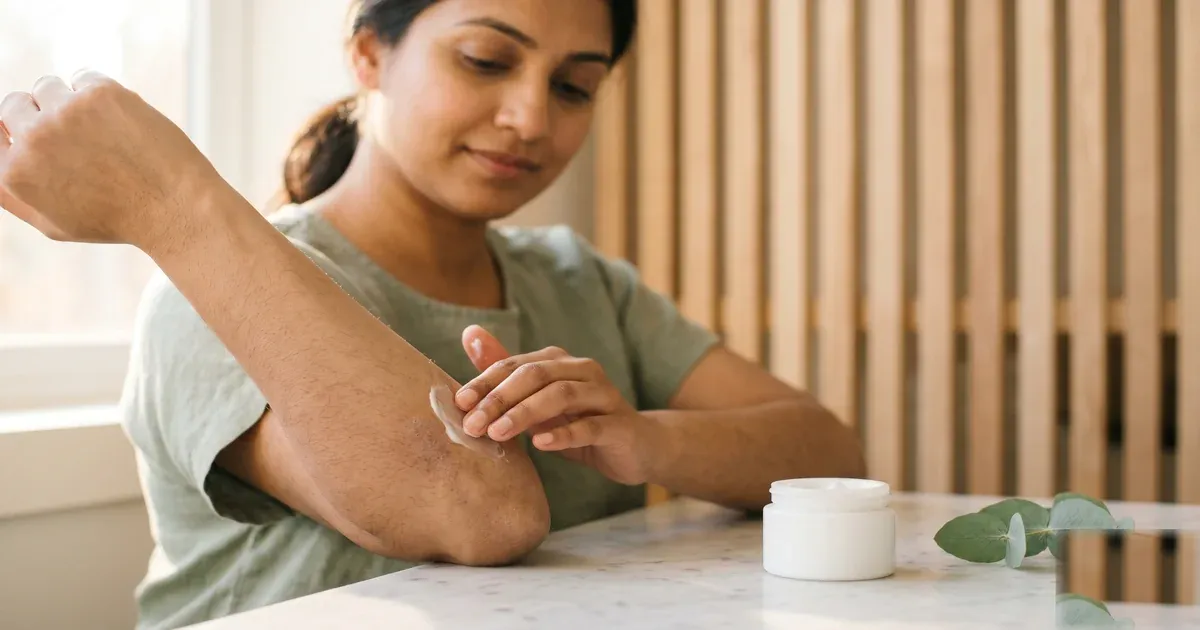
  • Moisturise within 3 minutes of patting dry. Twice daily minimum during flares; daily at all other times. Use ceramide-rich moisturisers (look for ceramide NP, ceramide AP, cholesterol, fatty acids on the label). Petrolatum-based ointments at night for dry hands and feet.
  • Cotton over synthetics — clothing, bed linen, towels. New clothes washed before wearing to remove sizing.
  • Avoid known triggers — once you know them. We work with patients to identify theirs rather than blanket-eliminating things.

Track 2: calm the inflammation (during flares, tapered after)

  • Topical corticosteroids — the first-line anti-inflammatory. Strength matched to site and age: weak for the face and folds, moderate-to-strong for limbs and trunk, applied for short courses (1–2 weeks at a time) on visible eczema. Used correctly under supervision, the safety profile is excellent.
  • Topical calcineurin inhibitors (tacrolimus, pimecrolimus) — non-steroid alternative for the face, eyelids, neck and folds, or as steroid-sparing maintenance.
  • Crisaborole / topical PDE4 inhibitors — newer non-steroid option in selected patients.
  • Antihistamines — sedating types at night help break the scratch cycle; non-sedating daytime use is less universally effective but still useful in patients with allergic comorbidities.
  • Wet-wrap therapy — for severe paediatric flares, a powerful short-term intervention used under guidance.

Track 3: systemic and advanced therapy (for moderate–severe disease)

When topicals aren’t enough — frequent flares, sleep disrupted, school missed, mental health affected:

  • Phototherapy (narrowband UVB) — well-tolerated, drug-free option in selected patients
  • Systemic immunosuppressants (methotrexate, cyclosporine, mycophenolate) — used in moderate–severe AD with monitoring
  • Biologics (dupilumab) — a significant recent advance for moderate–severe AD; safe long-term profile, targeted mechanism. We discuss them transparently with cost and access in mind.
  • JAK inhibitors (oral and topical) — emerging tools, used selectively

Track 4: manage what the skin barrier lets in

  • Treat any infection. AD skin is colonised with Staph aureus more than healthy skin; visible infection (yellow crust, sudden worsening) gets oral antibiotics and an antiseptic wash routine.
  • Address allergic comorbidities. Asthma, hay fever and AD travel together — treating one often improves the others.
  • Sleep, stress, and diet — addressed honestly. We don’t over-claim diet effects, but we don’t dismiss them either when the history points clearly to a trigger.

What not to do

  • Don’t over-bathe or bathe in hot water. Both worsen the barrier.
  • Don’t use “natural” coconut oil or mustard oil as a primary moisturiser. Some patients tolerate them; many find them comedogenic, photoirritating, or actively allergenic. Ceramide-rich moisturisers are a more reliable workhorse.
  • Don’t stop topical steroids the moment skin looks better. The inflammation under the surface is still active for a week or two after visible improvement. Tapering down rather than abrupt-stop prevents the rebound flare.
  • Don’t apply random Ayurvedic or herbal pastes to flares. Many contain plant allergens that worsen sensitive skin; the burning is often misread as “the cream is working.”
  • Don’t avoid topical steroids out of fear. Used correctly — right strength, right site, short courses — they’re safe. Topical-steroid-phobia is one of the most common reasons paediatric AD ends up under-treated and chronically inflamed.
  • Don’t self-medicate with oral steroids. Quick fix, fast rebound, real long-term cost.

Frequently asked questions

Will my child grow out of it? Many do, partially or fully. About half of children with AD see significant improvement by adolescence; some retain hand eczema or seasonal patches into adulthood. Early, consistent treatment improves long-term outcomes.

Is it caused by something in my child’s diet? For most children, no. For a minority — usually under age 2, with severe AD or clear time-correlation — yes. We test rather than guess, and we don’t recommend elimination diets without evidence.

Are topical steroids safe? Used correctly, yes — even in young children. The risks (skin thinning, stretch marks) come from prolonged unmonitored use of strong steroids on thin-skinned areas. Used with the right potency, in the right amount, for the right duration, they’re the safest effective option we have.

Is dupilumab right for me? For adults and adolescents with moderate–severe AD who haven’t responded to standard topicals and aren’t great candidates for traditional immunosuppressants, often yes. Side-effect profile is favourable, but it’s prescription, monitored, and ongoing. Worth discussing if you’re in that category.

Why does mine flare in Bengaluru’s monsoon? Humidity, sweat, indoor dust-mite proliferation, increased indoor time, AC-and-rain transitions, and the seasonal shift in air pollution all interact. We adjust regimens seasonally.

Can I use moisturiser if my skin doesn’t feel dry? Yes. AD skin loses water faster than it feels — moisturiser is preventive, not cosmetic. Daily moisturising during “quiet” periods reduces flare frequency.

When to see a dermatologist

  • Persistent itch that disrupts sleep
  • Visible eczema that doesn’t calm with over-the-counter creams in 1–2 weeks
  • Yellow crust, sudden worsening, or fever (signs of infection)
  • AD that’s affecting school, work or mental health
  • Repeated short-term steroid courses without a longer-term plan
  • Any concern about a child with moderate–severe AD

Where to go from here

Book a consultation — bring photos of the skin at its worst, a list of every cream you’ve tried, and a sense of what triggers you’ve already identified. We’ll build a plan that works during flares and between them.

Related reading:

Book a consultation with Dr Khushboo

Book consultation