
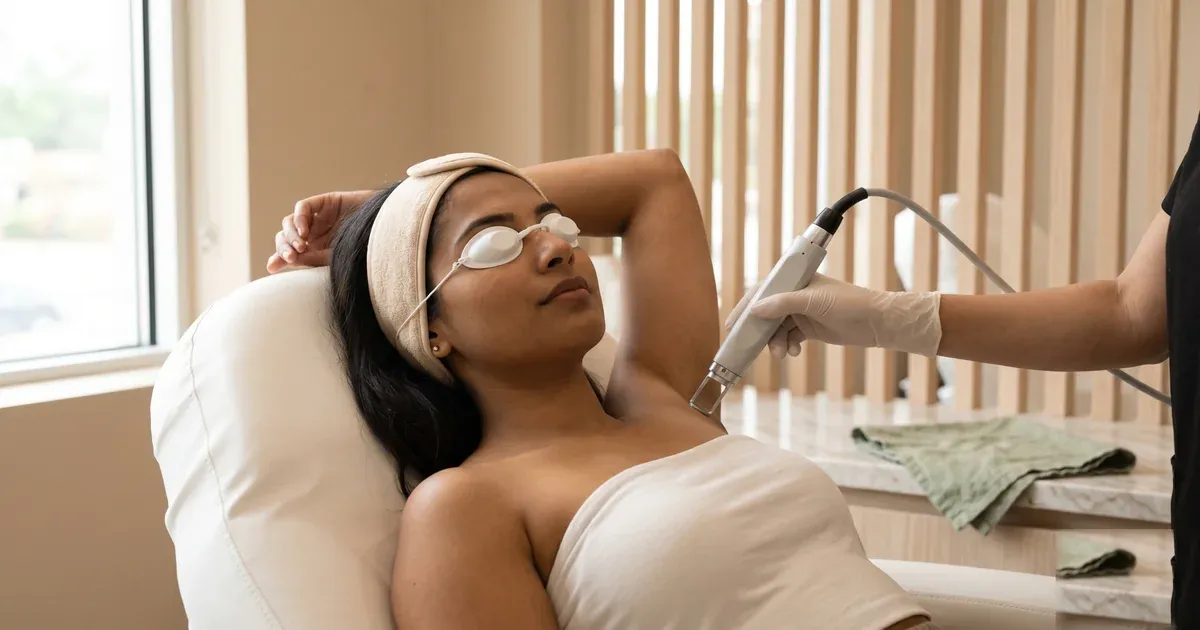
Laser hair reduction safety, devices and outcomes for Indian skin at SkinWise Clinic, Bengaluru.

By · Dermatologist, SkinWise Clinic Published Last reviewed

Laser hair reduction for Indian skin: the honest pillar guide

Most patients in our clinic have already done their midnight Google. They’ve read that laser is permanent. They’ve also read that laser burns dark skin. They’ve read posts from salons selling six sessions, posts from dermatologists warning against six sessions, and ad copy that promises smooth skin in a fortnight.

The truth about laser hair reduction is calmer and more nuanced than any of that. It works. It’s safe in Indian skin when the right device is used at the right settings on prepared skin. It isn’t one-and-done. It isn’t miracle “permanent.” And the difference between a great outcome and a disappointing one rarely comes down to the technology — it comes down to who’s pressing the trigger.

This is the long, honest guide. If you’ve been wondering how laser actually works on Indian skin (Fitzpatrick III–V), what to ask before booking, and what to expect after — you’re in the right place.

How laser hair reduction actually works

The technical name is selective photothermolysis. A laser delivers a wavelength of light that is preferentially absorbed by the pigment in hair follicles (melanin). The light energy converts to heat, the follicle is damaged enough to stop producing hair, and the surrounding skin — ideally — is unharmed.

Two things follow from that mechanism:

  1. Laser works best on hair that has pigment. Dark hair against contrasting skin is the classic ideal. White, grey or very light hairs respond poorly because there isn’t enough melanin to absorb the light.
  2. Laser only works on hair in the active growing (anagen) phase. Only about 20–30% of your hairs are in this phase at any moment. That’s why a single session can’t treat all your hairs — you need multiple sessions to catch each follicle in its anagen phase.

The whole point of choosing the right wavelength for Indian skin is to target the melanin in the follicle without overheating the melanin in the skin. Indian skin (Fitzpatrick IV–V) has more melanin than European skin, which makes the safety margin narrower. The wrong device or settings here causes burns, post-inflammatory hyperpigmentation, hypopigmentation, or paradoxical hair growth.

The hair growth cycle (why you need 6–8 sessions)

Three phases:

  • Anagen — active growth. The follicle is producing hair, the melanin target is at its richest, and the laser works.
  • Catagen — short transitional phase. Less effective.
  • Telogen — resting phase. The follicle is dormant; melanin in it is reduced; the laser largely misses it.

A given session treats only the follicles currently in anagen. Sessions are spaced 4–6 weeks apart on the face and 6–8 weeks apart on the body — designed to catch each follicle as it cycles back into the growing phase. Over 6–8 sessions, you progressively treat the majority of follicles in the area.

We tell patients this upfront because it explains:

  • Why “20% hair reduction per session” isn’t a sales line — it’s the underlying biology
  • Why doing sessions weeks too close together wastes money
  • Why hormonal areas (chin, jawline, upper lip) often need maintenance sessions in patients with PCOS or other hormonal drivers
  • Why a course completed two years ago can have some hairs return — they were dormant during the entire treatment course

Indian skin and laser: what makes us different

Three things to understand.

1. Indian skin has more melanin in the skin itself

This is the safety constraint. A laser tuned for European Fitzpatrick II skin will treat Fitzpatrick IV–V skin like a target too — heating the skin pigment, not just the follicle pigment. The result is burns, pigmentation changes, and occasionally permanent skin tone changes.

The right approach is a laser with a longer wavelength that bypasses surface melanin and reaches the deeper follicle.

2. We pigment after inflammation

Post-inflammatory hyperpigmentation (PIH) is the defining vulnerability of Indian skin in any procedure. A laser session that produces too much inflammation — wrong settings, wrong device, inadequate cooling, post-treatment sun exposure — leaves brown marks that may take 6–12 months to fade.

This is why proper laser hair reduction in Indian skin includes:

  • Strict daily sunscreen before and during the course
  • Appropriate device cooling (chilled tip or air cooling on every shot)
  • Test patches before treating large areas
  • Conservative starting energy with gradual escalation

3. We commonly have hormonal drivers — particularly PCOS

A significant fraction of our female laser-hair-reduction patients have underlying PCOS. Laser still works for them, but if the hormonal driver isn’t addressed, the hair will keep replacing itself faster than the laser can clear it. For PCOS patients we treat laser as one part of a combined plan — see our PCOS skin and hair service.

The devices that suit Indian skin

In honest, plain language:

Diode laser (commonly 800–810 nm, sometimes 755 nm with safety modifications)

Long the workhorse for Indian skin. Good melanin absorption with reasonable safety margin. Works well for body areas with thick, dark hair on Fitzpatrick III–IV skin. For Fitzpatrick V, results are good but the operator needs to be conservative with settings.

Nd:YAG laser (1064 nm)

The longest wavelength in common use. Bypasses surface melanin almost entirely, making it the safest option for darker skin tones (Fitzpatrick V–VI) and for tanned skin. Less efficient per session than diode on lighter skin — but “safer” usually wins on Indian skin.

For a deeper comparison see our diode vs Nd:YAG guide for Indian skin.

Triple wavelength (combined diode + Alexandrite + Nd:YAG)

Modern devices that allow the operator to switch wavelength on the same machine — useful in practice because patients often have different skin tones across areas and different hair types in different zones.

Alexandrite (755 nm)

Excellent on lighter skin (Fitzpatrick II–III) with dark hair. Generally not first choice for darker Indian skin tones because of the higher PIH and burn risk.

IPL (intense pulsed light)

Not actually a laser — broadband light. Useful for some applications, but for hair removal in Indian skin it’s not preferred: too broad a wavelength spectrum, higher risk of surface pigmentation, less precise targeting. The most common source of unsatisfactory or harmful “laser” experiences in our patient base is IPL marketed as laser.

Are you a good candidate?

You’re a strong candidate if:

  • Dark hair against any Indian skin tone
  • Reasonable expectations (significant reduction, not absolute permanence)
  • Willing to commit to 6–8 sessions spaced over 8–12 months
  • No active acne, infection or inflammation in the treatment area
  • Not currently pregnant
  • Underlying hormonal drivers (PCOS, thyroid) recognised and addressed

You may need adjustments or alternative plans if:

  • Hair is white, grey, or very fair (poor target for melanin-based lasers)
  • Very recent sun tan (treatment usually postponed until tan settles)
  • Pregnancy or breastfeeding (we generally defer)
  • Active eczema, psoriasis, or skin infection in the treatment area
  • History of keloid scarring (we discuss carefully and patch test)
  • Medications that cause photosensitivity (some antibiotics, some retinoids)

Special cases worth highlighting:

  • PCOS-related hirsutism — laser works but the hormonal driver needs parallel attention. We coordinate with gynaecology where appropriate.
  • Teenage facial hair — selectively appropriate, but we discuss expectations and timing carefully
  • Men’s beard shaping (e.g., neck hair only) — feasible; needs accurate mapping to avoid line discontinuity
  • Underarms and bikini — among the most rewarding areas; address the dark-skin component (post-inflammatory pigmentation) carefully

What a real treatment course looks like

Week before session 1

  • Stop waxing, plucking, threading and epilator use for 4 weeks before (the root needs to be in place)
  • Stop bleaching for 2 weeks before
  • Shave the area 12–24 hours before the session — laser needs short stubble, not no hair
  • Strict sunscreen on the area; avoid deliberate sun exposure
  • Stop topical retinoids 5–7 days before in sensitive areas
  • Inform the clinic about any medications, recent skin reactions, or planned events

The session itself

A typical 45–60 minute appointment:

  1. Cleansing of the area
  2. Gel applied (depending on device)
  3. Eye protection for both patient and operator
  4. Test shots to confirm comfortable energy
  5. Treatment passes across the area, with cooling between shots
  6. Post-treatment cooling and aloe / mild steroid cream as needed
  7. Sunscreen and aftercare instructions

Sensation: mild snap-like pinch or warm prickling. Tolerable. We adjust settings if it’s genuinely painful — pain is a useful signal, not a virtue.

Aftercare (3 days post-session)

  • Mild redness and slight bump-around-each-follicle is normal for hours to a day
  • Don’t apply scrubs, retinoids, or harsh actives for 3–5 days
  • No hot water, sauna, steam, vigorous gym, swimming pools for 2 days
  • Sunscreen religiously; the treated skin is briefly more pigmentation-prone
  • Some hairs will appear to “grow” in the days after — they’re being expelled. Don’t pluck them; they’ll shed.

Between sessions

  • Shave between sessions as needed — never wax, pluck or thread
  • Continue sunscreen
  • Note where regrowth is densest — useful for the next session’s targeting

Across the course

  • Sessions 1–3: visible reduction starts; reduction per session usually 20–25%
  • Sessions 4–6: dramatic improvement on most body sites
  • Sessions 7–8: residual fine hair only
  • Maintenance: 1–2 top-up sessions per year for hormonal areas; sometimes none needed for body areas

Side effects and what they actually mean

The safety profile of properly executed laser hair reduction is excellent. The honest list:

  • Redness and mild swelling in the hours after — common, transient
  • Itching for a day — common
  • Slight tenderness — usually mild
  • Mild superficial darkening at the hair follicle for days — expected; lifts as hairs shed
  • Post-inflammatory hyperpigmentation (PIH) — the most relevant adverse event in Indian skin; settles over weeks to months with sunscreen and time
  • Hypopigmentation — rare, usually temporary
  • Burns — should not happen with correct settings; if they do, it’s usually a sign that the device or settings weren’t right for the skin
  • Paradoxical hypertrichosis — rare, primarily on the face/upper arms in PCOS or hormonally driven patients; usually responds to higher energy or alternative wavelengths
  • Folliculitis — small acne-like spots in the treated area for a few days; settles with mild antiseptic and avoidance of friction

“Should not happen” is doing real work in that list. Most laser problems in Indian skin trace back to wrong device, wrong settings, or insufficient cooling — not to laser hair reduction itself.

What not to do

  • Don’t wax or pluck between sessions. The laser needs the root in place.
  • Don’t tan between sessions. A fresh tan is a relative contraindication and may force us to defer.
  • Don’t apply retinoids or harsh actives within a week of treatment.
  • Don’t book sessions weeks too close together to “speed things up.” The biology doesn’t bend for the calendar.
  • Don’t treat actively inflamed skin. Acne flare, eczema patch, recent piercing site — wait it out.
  • Don’t accept “laser” at a salon offering 6 sessions for a flat low price. It’s often IPL marketed as laser, with poor outcomes for Indian skin. Spend ten minutes asking which device, which wavelength, who operates it, and how many sessions are realistic — the answers reveal the clinic.
  • Don’t expect 100% permanent. “Reduction” is the accurate word. 80–90% reduction with maintenance is realistic.

Frequently asked questions

Is laser hair reduction permanent? The honest answer is long-term reduction, not permanent removal. Most patients see 80–90% reduction after a full course. Maintenance sessions every 6–12 months hold the result.

How many sessions will I need? 6–8 sessions for most patients, spaced 4–8 weeks apart depending on body area. Hormonal patients often benefit from periodic maintenance.

Is it safe during pregnancy? We defer laser hair reduction during pregnancy as a precaution, even though there’s no specific evidence of harm. Breastfeeding is generally OK for body areas; we discuss case by case.

Does it cause cancer? No. The laser energy is non-ionising — it doesn’t cause DNA damage like sunlight or X-rays.

Can I do it during my period? Yes — periods don’t change the treatment plan.

How is it different on the face vs the body? Facial hair often has different growth dynamics (hormonally driven), needs more sessions, and is more prone to paradoxical hypertrichosis in selected patients. We adjust settings accordingly and discuss expectations honestly.

What about cost? Cost varies by area, device, clinic, and number of sessions. See our laser hair reduction cost guide for Bengaluru for an honest breakdown.

Are at-home IPL devices any good? For Indian skin, generally underwhelming and occasionally risky. They’re cleared at low energies for safety reasons that limit efficacy. They may help fine hair on lighter skin tones; on Fitzpatrick IV–V they rarely match a clinic course.

My friend got laser at a salon and it didn’t work — why? Most often: wrong device for the skin tone (IPL on Fitzpatrick V), too few sessions, energy set too low for safety reasons, or the patient was waxing between sessions. Sometimes the diagnosis itself was off (PCOS not addressed).

The eBook — Smooth & Safe: Laser Hair Reduction for Indian Skin

If you want everything above in a single, longer, handbook-style read with pre-session checklists, a session tracker, and questions to ask a clinic before booking, we’ve written a free patient guide:

The book is free. We wrote it because too many of our patients arrived in the clinic having already been harmed by under-informed treatment elsewhere, and we wanted a thorough, India-specific reference that wasn’t marketing.

Where to go from here

If you’re considering laser hair reduction, book a laser hair reduction consultation — we’ll assess your skin and hair, discuss device choice and realistic expectations, and (if you decide to proceed) usually do a test patch the same day.

Related reading:

Book a consultation with Dr Khushboo

Book consultation